Should we give all surgeons cognitive enhancers to improve performance?
The "smart phone brain scanner". This could either be the best thing ever, or the worst thing.... I still have not decided.
The Royal Society has made 60,000 articles freely accessible. W00t!
... happy birthday, dear fMRI. Happy 20th birthday to you!
New ADHD guidelines allow for diagnosis in children as young as 4. (Which to me begs the question of what a "normal" 4 year old is supposed to act like).
What counts as a person in an era where some states are proposing laws to define a fertilized egg as a person? Neuroethics Canada has some intelligent commentary.
Monday, October 31, 2011


Friday, October 14, 2011
Sunday, October 9, 2011
Is the academic publishing industry evil?
Like most people, I didn't think much about the profit model for academic journals until I was publishing in them. Even after going through the process a few times, I am still struck by a feeling that academic journals are the toll trolls on the road of knowledge dissemination.
While a non-academic journal such as The Atlantic or the New Yorker pays its authors for content, academic journals get massive amounts of content volunteered to them. While non-academic journals pay an editor to hone and perfect the content, academic journals have volunteer peer reviewers and volunteer action editors doing this work for the cost of a line on the academic CV. Both types of journals offset some publication costs with advertising, but while non-academic journals sell for ~$5 per issue and under $50 for a year's subscription, an academic journal will charge $30-40 per article and thousands for a subscription. This means that the tax payer who funds this research is not able to afford to read the research.
Let's say you're an author, and you're submitting your article to a scientific journal. It gets reviewed and edited, and is accepted for publication by the action editor. Great! Your excitement gets diminished somewhat from two documents that get sent to you: one that signs over your copyright to the journal, and a publishing bill based on the number of pages and color figures in your work (often a few hundred dollars). Now, if you want to use a figure from this article again (say, for your doctoral dissertation), you must write the journal to get permission to use your own figure. Seriously. Other points against academic journals can be found in this entertainingly inflammatory piece.
But what about open access journals? Good question. These journals exist online, and anyone can read them, which is great for small libraries struggling to afford journal costs and citizens wishing to check claims at the source. They're not so great for the academic, who gets slapped with a $1000-2000 fee for publishing in them. As inexpensive as online infrastructure is these days, I would love for someone to explain to me how it costs the journal so much just to host a paper.
I was excited to read this interview with academic publishers Wiley and Elsevier on these issues. However, I find most of the responses to be non-answer run-arounds. A telling exception to this is in the first question "what is your position on Open Access databases?". Wiley responded:
While a non-academic journal such as The Atlantic or the New Yorker pays its authors for content, academic journals get massive amounts of content volunteered to them. While non-academic journals pay an editor to hone and perfect the content, academic journals have volunteer peer reviewers and volunteer action editors doing this work for the cost of a line on the academic CV. Both types of journals offset some publication costs with advertising, but while non-academic journals sell for ~$5 per issue and under $50 for a year's subscription, an academic journal will charge $30-40 per article and thousands for a subscription. This means that the tax payer who funds this research is not able to afford to read the research.
Let's say you're an author, and you're submitting your article to a scientific journal. It gets reviewed and edited, and is accepted for publication by the action editor. Great! Your excitement gets diminished somewhat from two documents that get sent to you: one that signs over your copyright to the journal, and a publishing bill based on the number of pages and color figures in your work (often a few hundred dollars). Now, if you want to use a figure from this article again (say, for your doctoral dissertation), you must write the journal to get permission to use your own figure. Seriously. Other points against academic journals can be found in this entertainingly inflammatory piece.
But what about open access journals? Good question. These journals exist online, and anyone can read them, which is great for small libraries struggling to afford journal costs and citizens wishing to check claims at the source. They're not so great for the academic, who gets slapped with a $1000-2000 fee for publishing in them. As inexpensive as online infrastructure is these days, I would love for someone to explain to me how it costs the journal so much just to host a paper.
I was excited to read this interview with academic publishers Wiley and Elsevier on these issues. However, I find most of the responses to be non-answer run-arounds. A telling exception to this is in the first question "what is your position on Open Access databases?". Wiley responded:
"The decision to submit a manuscript for publication in a peer-review journal reflects the researcher’s desire to obtain credentialing for the work described. The publishing process, from peer review through distribution and enabling discovery, adds value, which is manifest in the final version of the article and formally validates the research and the researcher."
(Emphasis mine).
In other words, we do this because there is a demand for our journal as a brand. You, researcher are creating the demand. However, I do hold out hope that as more publishing moves online, more researchers and librarians realize that there are both diamonds and rough in all journals, and this will wear away at brand prestige, allowing the illusion of "publisher added value" to wear away.
Friday, October 7, 2011
Insula-gate
For those just tuning into this week's latest installment of NeuroNonsense brought to you by the New York Times, let me being you up to date:
The New York Times allowed (nonscientist) Martin Lindstrom to once again use its Op-Ed space to "publish" non-peer reviewed "science".
Scientists, disgusted struck out at this perversion of science throughout the blogosphere (here, here, here, here though I'm sure I'm missing others). Dozens of prominent cognitive neuroscientists wrote a counter op-ed denouncing this practice (heavily edited by NYT staff).
At work the other day, a graduate student asked me why our field has a lower bar for press shenanigans and wildly implausible claims. I think there are several possible answers to this question (the fact that folk psychology seems to provide causally satisfactory explanations, the allure of pretty pictures of the brain "lighting up", or the intrinsic interest people take in their own brains all come to mind easily. However, I'm afraid that there's also a capitalist component to this one as well: Lindstrom makes his money convincing companies that his "science" will lead to better marketing outcomes. I can't think of a single case where someone impersonates a particle physicist or an inorganic chemist to sell snake oil.
The interest people take in their brains unfortunately creates this market for NeuroNonsense.
The New York Times allowed (nonscientist) Martin Lindstrom to once again use its Op-Ed space to "publish" non-peer reviewed "science".
Scientists, disgusted struck out at this perversion of science throughout the blogosphere (here, here, here, here though I'm sure I'm missing others). Dozens of prominent cognitive neuroscientists wrote a counter op-ed denouncing this practice (heavily edited by NYT staff).
At work the other day, a graduate student asked me why our field has a lower bar for press shenanigans and wildly implausible claims. I think there are several possible answers to this question (the fact that folk psychology seems to provide causally satisfactory explanations, the allure of pretty pictures of the brain "lighting up", or the intrinsic interest people take in their own brains all come to mind easily. However, I'm afraid that there's also a capitalist component to this one as well: Lindstrom makes his money convincing companies that his "science" will lead to better marketing outcomes. I can't think of a single case where someone impersonates a particle physicist or an inorganic chemist to sell snake oil.
The interest people take in their brains unfortunately creates this market for NeuroNonsense.
Tuesday, October 4, 2011
Soundbites, profoundly late
The Economist describes a fascinating new study that shows that people attribute less mind to vegetative patients than to dead persons.
Nature takes on the issue of work-life balance from both sides.
Over at The Atlantic, a nice piece on how deeply held cultural beliefs can kill.
Some hard numbers on prescription drug use for attention deficit hyperactivity disorder.
Jonah Lehrer provacatively asks "is corporate research more reliable than academic research?"
Interesting interview on the future of psychoactive pharmaceuticals.
Nature takes on the issue of work-life balance from both sides.
Over at The Atlantic, a nice piece on how deeply held cultural beliefs can kill.
Some hard numbers on prescription drug use for attention deficit hyperactivity disorder.
Jonah Lehrer provacatively asks "is corporate research more reliable than academic research?"
Interesting interview on the future of psychoactive pharmaceuticals.
Monday, September 26, 2011
Not the new truth serum.
Magnetic Pulses to the Brain Make it Impossible to Lie: Study
Zapping the brain with magnets makes it IMPOSSIBLE to lie, claim scientists
Holy crap! Hold on to your civil liberties...get your tin foil hat.... Something really exciting must be going on in neuroscience.
Right?
So it turns out that these articles refer to the following study:
Here, participants were shown red and blue circles and asked to name the color of the circle. At will, the participant could choose to lie or tell the truth about the color of the circle. However, while they were performing this task, repeated transcranial magnetic stimulation (rTMS) was applied to one of four brain areas (right or left dorsolateral prefrontal cortex (DLPFC), or right or left parietal cortex (PC)). TMS produces a transient magnetic field that produces electrical activity in the brain. As it is causing the brain to have different firing behavior, TMS allows researchers to gain insight into how certain brain areas cause behavior. Previously, the dorsolateral prefrontal cortex has been implicated in generated lies. Here, the authors sought to assess whether this area has a causal role in deciding whether or not to tell a lie. Here, the parietal cortex served as a control area as it is not generally implicated in the generation of lies.
So, is TMS to DLPFC the new truth serum? Here, I've re-plotted their results:
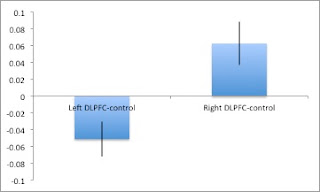
When TMS was applied to the left DFPFC (compared with the left PC), participants were less likely to choose to tell the truth whereas they were slightly more likely to be truthful when stimulation was applied to the right DLPFC. As you can see from the graph, the effect, although significant, is pretty tiny. The stimulation changes your propensity to lie or truth-tell about 5% in either direction. This cannot be farther from the "impossible to lie" headlines.
Interesting? Yes. Useful for law enforcement? Probably not.
Karton I, & Bachmann T (2011). Effect of prefrontal transcranial magnetic stimulation on spontaneous truth-telling. Behavioural brain research, 225 (1), 209-14 PMID: 21807030
Zapping the brain with magnets makes it IMPOSSIBLE to lie, claim scientists
Holy crap! Hold on to your civil liberties...get your tin foil hat.... Something really exciting must be going on in neuroscience.
Right?
So it turns out that these articles refer to the following study:
Here, participants were shown red and blue circles and asked to name the color of the circle. At will, the participant could choose to lie or tell the truth about the color of the circle. However, while they were performing this task, repeated transcranial magnetic stimulation (rTMS) was applied to one of four brain areas (right or left dorsolateral prefrontal cortex (DLPFC), or right or left parietal cortex (PC)). TMS produces a transient magnetic field that produces electrical activity in the brain. As it is causing the brain to have different firing behavior, TMS allows researchers to gain insight into how certain brain areas cause behavior. Previously, the dorsolateral prefrontal cortex has been implicated in generated lies. Here, the authors sought to assess whether this area has a causal role in deciding whether or not to tell a lie. Here, the parietal cortex served as a control area as it is not generally implicated in the generation of lies.
So, is TMS to DLPFC the new truth serum? Here, I've re-plotted their results:

When TMS was applied to the left DFPFC (compared with the left PC), participants were less likely to choose to tell the truth whereas they were slightly more likely to be truthful when stimulation was applied to the right DLPFC. As you can see from the graph, the effect, although significant, is pretty tiny. The stimulation changes your propensity to lie or truth-tell about 5% in either direction. This cannot be farther from the "impossible to lie" headlines.
Interesting? Yes. Useful for law enforcement? Probably not.
Karton I, & Bachmann T (2011). Effect of prefrontal transcranial magnetic stimulation on spontaneous truth-telling. Behavioural brain research, 225 (1), 209-14 PMID: 21807030
Saturday, September 3, 2011
Ambien "wakes up" the minimally conscious?
You really must watch this touching video of a man whose minimally conscious state can be alleviated for about an hour a day after taking the sleep drug, Ambien.
Of course, we can't say anything about how this effect might generalize as this is only one patient's experience, but you can see from the video just how amazing of an experience it is!
Of course, we can't say anything about how this effect might generalize as this is only one patient's experience, but you can see from the video just how amazing of an experience it is!
Subscribe to:
Posts (Atom)